API
API root URL
https://<FQDN>/api/v3
Repomanager exposes an API to manage repositories, mirrors, snapshots, environments, tasks and hosts.
From a client host (linupdate agent):
- Register or unregister a host into Repomanager
- Send general host information and packages information to Repomanager
- Retrieve the configuration of a host profile
From a desktop or a CI pipeline:
- Create, edit and delete curated repositories, local repositories and mirrors
- Sync repositories, point environments to snapshots, rebuild metadata
- Upload packages to a repository
- List hosts, their packages and their compliance
- ...
Note
API v2 is still available for compatibility, see API v2 (deprecated).
API key
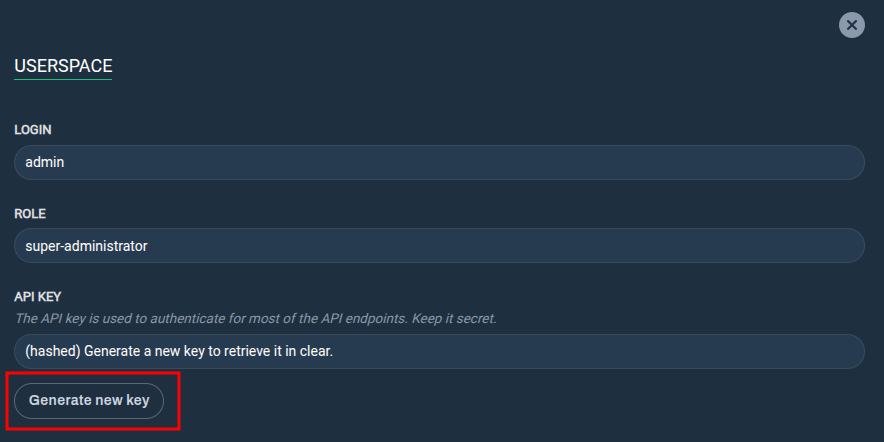
An API key must be retrieved from userspace.
Once generated, copy the key and keep it safe. This key is used to authenticate with the API and to perform certain actions when there is no host Id+token pair available.
Info
If a new API key is generated, the old key becomes invalid and unusable.
Authentication
Every request must be authenticated with the Authorization header:
Authorization: Bearer <APIKEY>: API key of a user. The permissions of the user apply: repositories and mirrors the user is not allowed to view are not listed and return a404error, actions the user is not allowed to perform return a403error.Authorization: Host <HOST_ID>:<HOST_TOKEN>: Id and token of a host, returned when the host registers. Only the routes used by the linupdate agent accept it.
Conventions
Responses
Successful responses are JSON objects with lowercase keys:
data: the requested resource or list of resources,nullwhen there is none (e.g. an action on a task).meta: optional information,message(information message) andpagination(see Pagination).
| Status code | Meaning |
|---|---|
200 |
Success |
201 |
Resource created (host registration), the Location header is the URL of the resource |
202 |
Task started or scheduled, the task is returned and the Location header is its URL |
400 |
Invalid request or parameters, or operation refused (e.g. protected environment) |
401 |
Missing or invalid authentication |
403 |
The user is not allowed to perform this action |
404 |
Route, repository, snapshot or other resource not found |
405 |
Method not allowed on this route, the Allow header lists the allowed methods |
500 |
Internal error, details are in the Repomanager logs |
503 |
Repomanager is being updated or is under maintenance |
Errors
Errors are returned as Problem Details objects (RFC 9457), with the application/problem+json content type:
{
  "type": "https://docs.repomanager.net/reference/api/#invalid-parameter",
  "title": "Invalid parameter",
  "status": 400,
  "detail": "Unknown parameter(s): descripton. Valid parameters are: description, tags, retention, retention_keep_all",
  "code": "invalid_parameter",
  "errors": [
    { "detail": "Unknown parameter", "pointer": "#/descripton" }
  ]
}
type,title,status,detail: standard members,detailis the explanation of the error.code: stable error code, scripts should rely on it rather than ondetail.errors: parameters in error, when they are known.pointeris the JSON Pointer (RFC 6901) of a body parameter,parameteris the name of a query parameter.
| Code | Status | Meaning |
|---|---|---|
invalid_request |
400 |
Invalid request (e.g. nothing to edit, no file uploaded) |
invalid_parameter |
400 |
A parameter has an invalid value or type, or is unknown |
missing_parameter |
400 |
A required parameter is missing |
operation_refused |
400 |
The operation is refused by Repomanager (e.g. protected environment, existing repository, invalid repository name) |
unauthorized |
401 |
Missing or invalid authentication |
forbidden |
403 |
The user is not allowed to perform this action |
not_found |
404 |
The route or the resource does not exist |
method_not_allowed |
405 |
The method is not allowed on this route |
internal_error |
500 |
Internal error, details are in the Repomanager logs |
unavailable |
503 |
Repomanager is being updated or is under maintenance |
Parameters
- Parameters are sent as a JSON body (
Content-Type: application/json), except for files uploads which are multipart requests (-F). - Keys are lowercase (
package_type,gpg_sign...), booleans are JSON booleans (true/false). - Parameters accepting a list also accept a single value (
"environments": "prod"is the same as"environments": ["prod"]). - Unknown parameters are refused with an
invalid_parametererror, to report misspelled parameters.
Pagination
The lists of tasks, hosts and hosts packages are paginated with the limit (1 to 1000, default 100) and offset (default 0) query parameters:
curl --fail-with-body -L -s -H "Authorization: Bearer <APIKEY>" "https://repomanager.mydomain.net/api/v3/tasks?limit=50&offset=100"
The pagination is returned in meta.pagination (total, limit, offset), and the Link header (RFC 8288) contains the URL of the next and previous pages:
Link: </api/v3/tasks?limit=50&offset=150>; rel="next", </api/v3/tasks?limit=50&offset=50>; rel="prev"
Tasks
Operations that modify the content of repositories (creation, sync, environment pointing, deletion...) are executed in background by a task. They return a 202 response with the task, and its URL in the Location header:
{
  "data": {
    "id": 42,
    "action": "update",
    "status": "queued",
    ...
  },
  "meta": {
    "message": "Sync of mirror #3 started"
  }
}
The task can be followed with GET /tasks/<TASK_ID>. When an operation creates several tasks (e.g. deleting a repository with several snapshots), they are grouped under a parent task, which is returned.
Scheduling
Operations executed by a task accept an optional schedule parameter to execute them later instead of immediately. The schedule types allowed depend on the operation: for example, a sync or a metadata rebuild can be recurring, a repository creation cannot.
"schedule": {
  "type": "unique",
  "date": "2026-12-31",
  "time": "22:00",
  "notify_error": true,
  "notify_success": false,
  "reminders": [1, 3],
  "recipients": ["admin@example.com"]
}
| Parameter | Description |
|---|---|
type |
unique or recurring (required) |
date |
Execution date YYYY-MM-DD (unique) |
time |
Execution time HH:MM (unique, and daily, weekly, monthly frequencies) |
frequency |
hourly, daily, weekly, monthly or cron (recurring) |
days |
List of days for the weekly frequency: monday, tuesday... |
monthly_day, monthly_day_position |
Day of the month for the monthly frequency, e.g. monday and first (first, second, third, last) |
cron |
Cron expression for the cron frequency |
notify_error, notify_success |
Send an email when the task fails or succeeds (default false) |
reminders |
Send a reminder email the specified number of days before the execution |
recipients |
Emails of the notifications and reminders recipients |
Repositories
Repositories are addressed by their type and their Id: /repositories/<TYPE>/<ID>.
<TYPE>iscurated,localormirror.<ID>is the Id of the repository, returned when listing repositories. Curated and local repositories share the same Ids, mirrors have their own.- Snapshots are addressed within their repository:
/repositories/<TYPE>/<ID>/snapshots/<SNAPSHOT_ID>.
The type is checked: requesting a local repository with the curated type returns a 404 error. Routes that only apply to some types (packages, metadata rebuild...) return a 404 error for the other types.
| Endpoint | Description |
|---|---|
GET /repositories |
List all repositories (curated, local and mirrors). Optional filters: ?package_type=deb, ?tag=<TAG>, ?group=<GROUP> |
GET /repositories/<TYPE> |
List the repositories of a type, same filters |
POST /repositories/<TYPE> |
Create a repository (task) |
GET /repositories/<TYPE>/<ID> |
Repository details, with its snapshots |
PATCH /repositories/<TYPE>/<ID> |
Edit the repository properties |
DELETE /repositories/<TYPE>/<ID> |
Delete the repository with all its snapshots (task) |
POST /repositories/<TYPE>/<ID>/rename |
Rename the repository (task, curated and local repositories). Parameter: name |
Create a curated repository
curl --fail-with-body -L -s -X POST -H "Authorization: Bearer <APIKEY>" -H "Content-Type: application/json" \
  -d '{"package_type": "deb", "source": "debian", "dist": "trixie", "section": "main", "arch": ["amd64"], "environments": ["preprod"]}' \
  https://repomanager.mydomain.net/api/v3/repositories/curated
| Parameter | Description |
|---|---|
package_type |
rpm or deb (required) |
source |
Source repository name (required) |
name |
Repository name, the source repository name by default |
releasever |
Release version (rpm, required). A list creates a repository for each release version |
dist, section |
Distribution and component (deb, required). Lists create a repository for each distribution and component |
arch |
Architectures, the default architectures of the settings by default |
gpg_check |
Check the GPG signatures of the source repository (default true) |
gpg_sign |
Sign the repository with GPG, as defined in the settings by default |
environments |
Environments to point to the first snapshot |
description, tags, group |
Description, list of tags and group name |
retention, retention_keep_all |
Number of unused snapshots to keep (null: global setting), or keep all of them |
advanced_params |
Packages to sync and metadata, see below |
schedule |
See Scheduling |
advanced_params:
"advanced_params": {
  "packages": { "include": ["nginx*"], "exclude": [], "keep_latest": 3 },
  "metadata_sync": { "comps": true, "modules": true, "updateinfo": true },
  "metadata_custom_fields": { "origin": "", "label": "", "description": "" }
}
metadata_sync only applies to rpm repositories, metadata_custom_fields to deb repositories.
Create a local repository
curl --fail-with-body -L -s -X POST -H "Authorization: Bearer <APIKEY>" -H "Content-Type: application/json" \
  -d '{"package_type": "rpm", "name": "my-apps", "releasever": "9", "environments": ["preprod"]}' \
  https://repomanager.mydomain.net/api/v3/repositories/local
Same parameters as a curated repository, name is required. source, gpg_check and advanced_params do not apply.
Create a mirror
curl --fail-with-body -L -s -X POST -H "Authorization: Bearer <APIKEY>" -H "Content-Type: application/json" \
  -d '{"package_type": "deb", "source": "debian", "dists": ["trixie", "trixie-updates"], "components": ["main"], "arch": ["amd64"]}' \
  https://repomanager.mydomain.net/api/v3/repositories/mirror
| Parameter | Description |
|---|---|
package_type |
rpm, deb or arch (required) |
source |
Source repository name (required) |
arch |
Architectures (required) |
name |
Mirror name, the source repository name by default |
releasever |
Release version (rpm, required) |
dists, components |
Distributions and components (deb, not needed for flat repositories) |
repos |
Repositories (arch, e.g. core, extra) |
gpg_check |
Check the GPG signatures of the source repository (default true) |
environments, description, tags, group, retention, retention_keep_all, schedule |
Same as curated repositories |
Edit a repository
curl --fail-with-body -L -s -X PATCH -H "Authorization: Bearer <APIKEY>" -H "Content-Type: application/json" \
  -d '{"description": "Debian main repository", "tags": ["debian", "prod"], "retention": 5}' \
  https://repomanager.mydomain.net/api/v3/repositories/curated/<ID>
Only the specified properties are edited: description, tags, retention, retention_keep_all, and source for curated repositories. The edited repository is returned.
Snapshots
| Endpoint | Description |
|---|---|
GET /repositories/<TYPE>/<ID>/snapshots |
List the snapshots, most recent first |
POST /repositories/<TYPE>/<ID>/snapshots |
Create a new snapshot (task): sync from the source repository (curated repositories and mirrors), or copy of the latest snapshot to add packages to (local repositories) |
GET /repositories/<TYPE>/<ID>/snapshots/<SNAPSHOT_ID> |
Snapshot details, with the environments pointing to it and their URL |
DELETE /repositories/<TYPE>/<ID>/snapshots/<SNAPSHOT_ID> |
Delete the snapshot (task). A curated or local repository is deleted with its last snapshot |
POST /repositories/<TYPE>/<ID>/snapshots/<SNAPSHOT_ID>/rebuild |
Rebuild the snapshot metadata (task, curated and local repositories). Parameter: gpg_sign (current signature by default) |
POST /repositories/<TYPE>/<ID>/snapshots/<SNAPSHOT_ID>/duplicate |
Duplicate the snapshot into a new repository (task, curated and local repositories). Parameters: name (required), environments, description, tags, group |
GET /repositories/<TYPE>/<ID>/snapshots/<SNAPSHOT_ID>/diff/<OTHER_SNAPSHOT_ID> |
Packages added and removed in the snapshot compared to the other snapshot, e.g. a new snapshot compared to the previous one (curated and local repositories): added lists the packages of the snapshot missing from the other one, removed the packages of the other snapshot missing from the snapshot. Add ?other_repository=<TYPE>/<ID> to compare with a snapshot of another repository |
Parameters of a new snapshot (all optional):
- curated repositories:
arch,gpg_check,gpg_sign,advanced_params,environments,schedule. Unspecified values are the settings of the latest snapshot. - local repositories:
arch,gpg_sign,environments,schedule. - mirrors:
environments,schedule.
# Sync a mirror and point the preprod environment to the new snapshot
curl --fail-with-body -L -s -X POST -H "Authorization: Bearer <APIKEY>" -H "Content-Type: application/json" \
  -d '{"environments": ["preprod"]}' \
  https://repomanager.mydomain.net/api/v3/repositories/mirror/<ID>/snapshots

# Sync a curated repository every night
curl --fail-with-body -L -s -X POST -H "Authorization: Bearer <APIKEY>" -H "Content-Type: application/json" \
  -d '{"schedule": {"type": "recurring", "frequency": "daily", "time": "02:00"}}' \
  https://repomanager.mydomain.net/api/v3/repositories/curated/<ID>/snapshots
Environments
| Endpoint | Description |
|---|---|
GET /environments |
List the environments. A protected environment cannot be pointed nor removed |
POST /repositories/<TYPE>/<ID>/snapshots/<SNAPSHOT_ID>/environments |
Point environment(s) to the snapshot (task). Parameters: environments (required), schedule |
DELETE /repositories/<TYPE>/<ID>/snapshots/<SNAPSHOT_ID>/environments/<ENV> |
Remove an environment from the snapshot (task) |
curl --fail-with-body -L -s -X POST -H "Authorization: Bearer <APIKEY>" -H "Content-Type: application/json" \
  -d '{"environments": ["prod"]}' \
  https://repomanager.mydomain.net/api/v3/repositories/local/<ID>/snapshots/<SNAPSHOT_ID>/environments
Packages
Curated and local repositories only.
| Endpoint | Description |
|---|---|
GET /repositories/<TYPE>/<ID>/snapshots/<SNAPSHOT_ID>/packages |
List the packages of the snapshot |
POST /repositories/<TYPE>/<ID>/snapshots/<SNAPSHOT_ID>/packages |
Upload packages (multipart request). Optional fields: overwrite, ignore_if_exists (true / false) |
DELETE /repositories/<TYPE>/<ID>/snapshots/<SNAPSHOT_ID>/packages |
Delete packages by file name. Parameter: packages (required) |
The snapshot metadata must then be rebuilt to make the changes available.
curl --fail-with-body -L -s -X POST -H "Authorization: Bearer <APIKEY>" \
  -F "packages[]=@my-app_1.0.0_amd64.deb" -F "packages[]=@my-lib_1.0.0_amd64.deb" \
  https://repomanager.mydomain.net/api/v3/repositories/local/<ID>/snapshots/<SNAPSHOT_ID>/packages

curl --fail-with-body -L -s -X POST -H "Authorization: Bearer <APIKEY>" -H "Content-Type: application/json" \
  -d '{"gpg_sign": true}' \
  https://repomanager.mydomain.net/api/v3/repositories/local/<ID>/snapshots/<SNAPSHOT_ID>/rebuild
Source repositories
These endpoints require the permission to edit source repositories, as their definition can contain credentials.
| Endpoint | Description |
|---|---|
GET /sources |
List the source repositories. Optional filter: ?package_type=deb (deb, rpm or arch) |
GET /sources/<PACKAGE_TYPE>/<NAME> |
Source repository details |
POST /sources/import |
Import source repositories from a template file (multipart request, file field template) |
curl --fail-with-body -L -s -X POST -H "Authorization: Bearer <APIKEY>" -F "template=@/path/to/template.yml" \
  https://repomanager.mydomain.net/api/v3/sources/import
Tasks
| Endpoint | Description |
|---|---|
GET /tasks |
List the tasks. Optional filter: ?status=running (running, queued, scheduled or done) |
GET /tasks/<TASK_ID> |
Task details: status, targeted repository, schedule... |
POST /tasks/<TASK_ID>/enable |
Enable a disabled scheduled task |
POST /tasks/<TASK_ID>/disable |
Disable a scheduled task not executed yet. A recurring task gets a new Id at each execution: the error returned for an executed task gives the Id of its next occurrence |
POST /tasks/<TASK_ID>/stop |
Stop a running task |
POST /tasks/<TASK_ID>/relaunch |
Relaunch a task, returns the Id of the new task |
DELETE /tasks/<TASK_ID> |
Delete a task |
Hosts
| Endpoint | Authentication | Description |
|---|---|---|
GET /hosts |
API key | List the hosts, see filters below |
GET /hosts/<HOST_ID> |
API key or host | Host details (a host can only access its own data) |
GET /hosts/<HOST_ID>/packages/installed |
API key or host | Installed packages of a host (paginated) |
GET /hosts/<HOST_ID>/packages/available |
API key or host | Available updates of a host (paginated) |
DELETE /hosts/<HOST_ID> |
API key | Delete a host |
Filters of GET /hosts, they can be combined:
- properties:
?os=ubuntu,?os_version=24.04,?os_family=Debian,?kernel=<KERNEL>,?arch=x86_64,?type=<VIRTUALIZATION>,?profile=<PROFILE>,?env=prod - status:
?status=uptodate,outdated,compliantornon-compliant. Add&packagesto include the list of available updates - package:
?package=nginx, with optional&version=<VERSION>,&strict_name,&strict_version(or&strictfor both),&absentto list the hosts on which the package is not installed
curl --fail-with-body -L -s -X GET -H "Authorization: Bearer <APIKEY>" \
  "https://repomanager.mydomain.net/api/v3/hosts?os=debian&status=outdated&packages"
linupdate agent
| Endpoint | Authentication | Description |
|---|---|---|
POST /hosts |
API key | Register a host. Parameters: ip, hostname. Returns the id and token the host must authenticate with (data.id, data.token) |
DELETE /hosts/me |
Host | Unregister the authenticated host |
PUT /hosts/me/status |
Host | Send the host general information: hostname, os, os_version, os_family, type, cpu, ram, network, kernel, arch, profile, env, agent_status, agent_version, reboot_required, uptime, public_ip, behind_nat. If network contains all the addresses of each interface (addresses) and the main interface (main), the registered IP is replaced by the main IP when the host no longer owns it. public_ip is cleared when the host does not send it and is not declared behind_nat. Returns the updated values in data.updated |
PUT /hosts/me/packages/installed |
Host | Send the installed packages. Parameter: installed_packages |
PUT /hosts/me/packages/available |
Host | Send the available updates. Parameter: available_packages |
PUT /hosts/me/packages/events |
Host | Send the packages events history. Parameter: events |
GET /profiles/<PROFILE> |
API key or host | Profile configuration (packages exclusions, services to reload or restart...) |
GET /profiles/<PROFILE>/repositories |
API key or host | Repositories of the profile, as configured on the host |
GET /profiles |
API key | List the profiles |
Migrating from API v2
The main changes:
- Repositories and mirrors are a single resource,
/repositories/<TYPE>/<ID>, and snapshots are addressed within their repository. - Responses have a new format:
dataandmetainstead ofresults,message,rcandreturn, and errors are Problem Details objects with a stablecode(see Responses and Errors). - Response keys are always lowercase (
Package_typeis nowpackage_type), the?normalizeparameter is removed. - Operations executed by a task return the task (
data.idis its Id) instead oftask-id. - Responses use the appropriate HTTP status codes (
404,403...) instead of400for every error, and an empty list is a successful response. - Repositories can be created, synced, edited and deleted.
| API v2 | API v3 |
|---|---|
GET /repo/ |
GET /repositories |
GET /repo/<ID> |
GET /repositories/<TYPE>/<ID>/snapshots |
GET /snapshot/<SNAPSHOT_ID>/ |
GET /repositories/<TYPE>/<ID>/snapshots/<SNAPSHOT_ID> |
GET /snapshot/<SNAPSHOT_ID>/packages |
GET /repositories/<TYPE>/<ID>/snapshots/<SNAPSHOT_ID>/packages |
GET /snapshot/<SNAPSHOT_ID>/diff/<SNAPSHOT_ID> |
GET /repositories/<TYPE>/<ID>/snapshots/<SNAPSHOT_ID>/diff/<SNAPSHOT_ID> (the comparison is reversed: the second snapshot is now the reference) |
POST /snapshot/<SNAPSHOT_ID>/upload |
POST /repositories/<TYPE>/<ID>/snapshots/<SNAPSHOT_ID>/packages (ignore-if-exists is now ignore_if_exists) |
DELETE /snapshot/<SNAPSHOT_ID>/packages |
DELETE /repositories/<TYPE>/<ID>/snapshots/<SNAPSHOT_ID>/packages |
PUT /snapshot/<SNAPSHOT_ID>/rebuild (gpgSign) |
POST /repositories/<TYPE>/<ID>/snapshots/<SNAPSHOT_ID>/rebuild (gpg_sign) |
PATCH /environment/<ENV>/point |
POST /repositories/<TYPE>/<ID>/snapshots/<SNAPSHOT_ID>/environments |
GET /mirror/ |
GET /repositories/mirror |
GET /mirror/<ID>/ |
GET /repositories/mirror/<ID> |
POST /mirror/<ID>/sync |
POST /repositories/mirror/<ID>/snapshots |
POST /mirror/<ID>/env |
POST /repositories/mirror/<ID>/snapshots/<SNAPSHOT_ID>/environments |
GET /source/, GET /source/<TYPE>/ |
GET /sources, GET /sources?package_type=<TYPE> |
GET /source/<TYPE>/<NAME> |
GET /sources/<TYPE>/<NAME> |
POST /source/<TYPE>/import |
POST /sources/import |
GET /tasks/, GET /tasks/<STATUS> |
GET /tasks, GET /tasks?status=<STATUS> |
GET /task/<TASK_ID>/ |
GET /tasks/<TASK_ID> |
POST /task/<TASK_ID>/enable (disable, stop) |
POST /tasks/<TASK_ID>/enable (disable, stop) |
DELETE /task/<TASK_ID>/delete |
DELETE /tasks/<TASK_ID> |
GET /hosts/<FILTER>/<VALUE> |
GET /hosts?<FILTER>=<VALUE> |
GET /hosts/uptodate, outdated, compliant, non-compliant |
GET /hosts?status=<STATUS> |
GET /host/<HOST_ID>/installed, /host/<HOST_ID>/updates |
GET /hosts/<HOST_ID>/packages/installed, /hosts/<HOST_ID>/packages/available |
POST /host/registering |
POST /hosts |
DELETE /host/registering |
DELETE /hosts/me (host), DELETE /hosts/<HOST_ID> (API key) |
PUT /host/status |
PUT /hosts/me/status |
PUT /host/packages/installed, available, event |
PUT /hosts/me/packages/installed, available, events |
GET /profile/, GET /profile/<PROFILE> |
GET /profiles, GET /profiles/<PROFILE> |
GET /profile/<PROFILE>/repos?new-format |
GET /profiles/<PROFILE>/repositories |
GET /profile/<PROFILE>/excludes has no equivalent, the packages exclusions are part of the profile configuration (GET /profiles/<PROFILE>). GET /profile/server-settings has no equivalent either.